

Every NBA fan has seen it at least once. You open the pre-game injury report. A star player appears beside a short label: GTD.
That tiny three-letter abbreviation can change everything.
Fans start speculating. Fantasy managers panic. Sportsbooks quietly adjust odds. Meanwhile, coaches stay silent until the final minutes before tip-off.
So what does GTD mean in NBA injury reports, and why does it matter so much?
This guide explains the term in plain language. You’ll learn how teams use it, why players receive it, how it affects fantasy basketball, and how to read NBA injury reports like an insider.
By the end, the mystery behind GTD status NBA reports will feel surprisingly simple.
What Does GTD Mean in NBA?
The term GTD stands for Game Time Decision.
When a player carries a GTD status, the coaching staff hasn’t decided if the athlete will play. The final call happens shortly before the game begins.
Usually that decision comes during warm-ups after trainers evaluate the player’s condition.
Simple definition:
| Term | Meaning |
|---|---|
| GTD | Game Time Decision |
| Usage | Player availability determined shortly before tip-off |
A player listed as GTD might:
- Play full minutes
- Play limited minutes
- Sit out entirely
That uncertainty creates intrigue around the game.
Fans refresh injury reports repeatedly. Analysts debate possibilities on television. Fantasy managers keep their bench ready.
In short, GTD keeps everyone guessing until the last minute.
What Does GTD Mean in Basketball?
While the NBA made the term famous, the phrase Game Time Decision appears across many sports.
You’ll hear it in:
- NCAA basketball
- International basketball leagues
- Football broadcasts
- Hockey commentary
However, basketball fans use the term constantly because the NBA injury reporting system requires frequent updates.
Why Basketball Uses GTD So Often
Basketball players deal with recurring minor injuries throughout an 82-game season.
Examples include:
- Mild ankle sprains
- Knee soreness
- Muscle tightness
- Back stiffness
These issues rarely require long recovery periods. Yet medical staff still monitor them carefully.
Instead of declaring a player out immediately, teams often wait until pre-game warm-ups.
That’s when the final evaluation occurs.
This approach explains why gtd meaning basketball discussions dominate sports media every night during the season.
GTD Meaning Basketball Fans Should Know
At first glance, GTD looks vague. That’s intentional.
Teams prefer flexibility.
If medical staff aren’t certain about a player’s condition, they list him as GTD instead of locking in a final decision early.
What GTD Usually Indicates
Most GTD cases involve minor injuries or soreness, not severe problems.
Typical situations include:
- A player rolled his ankle last game.
- The athlete experienced muscle tightness during practice.
- Trainers want to monitor swelling before tip-off.
Here’s the key point many fans misunderstand.
GTD does not mean the player is seriously injured.
In fact, many GTD players end up playing.
Sports analysts often mention a simple rule:
“If a player participates in warm-ups, chances are high he’ll play.”
Still, uncertainty remains until the coach confirms the lineup.
What Is GTD in NBA Injury Reports?
To understand what is GTD in NBA injury reports, it helps to see how official reports work.
The NBA requires teams to release injury updates before games.
These reports list:
- Injured players
- Injury type
- Availability status
A typical report looks like this:
| Player | Team | Injury | Status |
|---|---|---|---|
| Player Name | Team | Right ankle soreness | GTD |
| Player Name | Team | Knee inflammation | Questionable |
| Player Name | Team | Hamstring strain | Out |
The GTD status NBA reports signal uncertainty rather than a confirmed absence.
Fans should treat GTD as a probability scenario, not a final answer.
How NBA Teams Use GTD Status
NBA teams rely on Game Time Decision status for several strategic and medical reasons.
It allows flexibility while protecting players.
Let’s examine how the process works behind the scenes.
Read Also: Plancha Meaning: Definition, Uses, and Cooking Tips Explained
Pre-Game Evaluation Process
Before tip-off, trainers and coaches evaluate injured players through several steps.
The typical evaluation process
- Morning treatment session
- Light movement drills
- Physical therapy and stretching
- Pre-game warm-up testing
- Final decision by coach and medical staff
During warm-ups, trainers check:
- Range of motion
- Pain level
- Stability in injured areas
- Conditioning level
If everything looks good, the coach gives the green light.
Otherwise, the player sits.
This careful approach reduces the risk of aggravating injuries.
Strategic Reasons Teams Use GTD
Beyond medical caution, GTD can also create a strategic advantage.
Opposing teams struggle to prepare when a star player’s availability remains uncertain.
For example:
- If a superstar might play, defenses must plan differently.
- Coaches must prepare two game plans.
That uncertainty keeps opponents guessing.
Strategic benefits include
- Opponent uncertainty
- Roster flexibility
- Player protection
However, the NBA monitors injury reporting carefully to prevent manipulation.
Teams must provide accurate updates under league rules.
Common Reasons Players Receive GTD Status
Most GTD designations involve short-term physical issues rather than major injuries.
Below are the most common reasons.
Minor Injuries
Minor injuries occur frequently during the long NBA season.
Players run, jump, and collide dozens of times each game.
Even elite athletes experience wear and tear.
Common examples include:
- Ankle soreness
- Mild sprains
- Knee inflammation
- Muscle tightness
These injuries often improve quickly with treatment.
Therefore teams hesitate to rule players out immediately.
Recovery Monitoring
Players returning from injury often receive GTD status.
Medical staff want to see how the body responds during activity.
A player might feel fine walking. Running tells a different story.
Warm-ups provide the final test.
If the body responds well, the player plays.
Load Management
Modern basketball places greater emphasis on player longevity.
Teams protect stars from excessive strain during long seasons.
Situations that trigger GTD for load management include:
- Back-to-back games
- Long road trips
- Heavy minute workloads
This approach keeps players healthy for playoff runs.
Official NBA Injury Report Flow
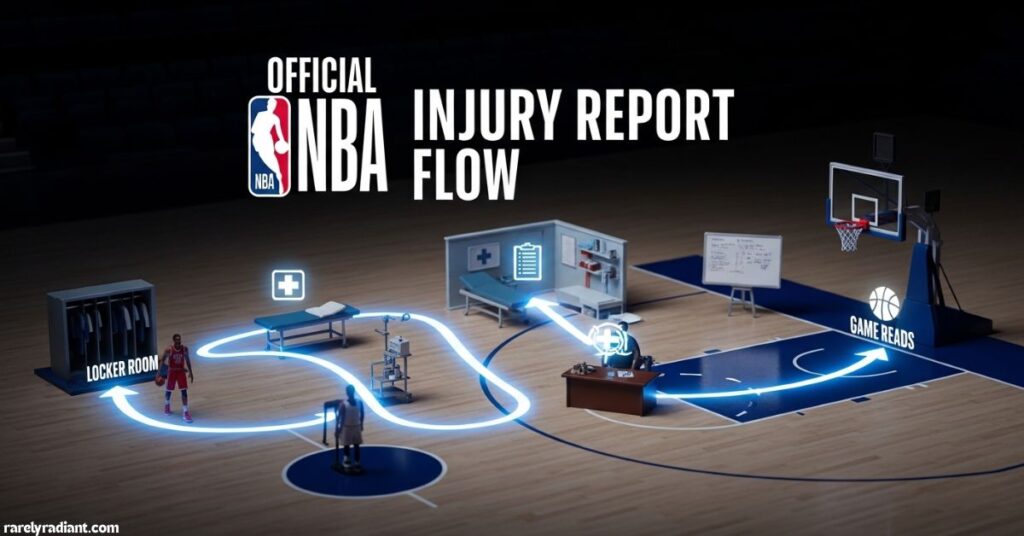
The NBA maintains strict reporting guidelines.
Teams must release injury updates at specific times.
Understanding this timeline helps fans track gtd status NBA updates more accurately.
Injury Report Schedule
The league requires multiple updates before tip-off.
Here is the standard timeline.
| Time | Injury Report Update |
|---|---|
| Morning | Initial report released |
| Afternoon | Updated player status |
| 30–60 minutes before game | Final availability decision |
These updates ensure transparency for fans, media, and betting markets.
For official guidelines, the NBA publishes policies here:
Read Also: Poison Tree Tattoo Meaning: Symbolism, History, and Hidden Messages
How People Use “GTD” in Real NBA Conversations
The term appears everywhere in basketball culture.
From locker rooms to television broadcasts, GTD has become common vocabulary.
Fans and Social Media
Fans constantly discuss GTD players online.
Typical conversations include:
- Predicting whether a star will play
- Analyzing injury history
- Sharing insider updates
A tweet minutes before tip-off can spark massive reactions.
Analysts and Broadcasters
Television commentators frequently mention GTD during pre-game coverage.
Typical commentary sounds like this:
“The team listed him as GTD earlier today. We’ll know more after warm-ups.”
This brief phrase instantly informs viewers.
It tells them the player might appear on the court.
Betting Communities
Sports betting markets react quickly to injury news.
A single GTD announcement can shift point spreads.
For example:
| Scenario | Impact |
|---|---|
| Star player likely playing | Odds shift toward that team |
| Star player ruled out | Opponent odds improve |
Because of this, bettors monitor injury reports closely.
When GTD Status Becomes Important
While casual fans might ignore injury reports, serious basketball followers know they matter.
Several groups rely heavily on GTD updates.
For Fans Watching the Game
Star players drive excitement.
A last-minute GTD update can change the entire viewing experience.
Imagine expecting a superstar matchup. Suddenly one player sits.
The atmosphere shifts immediately.
For Fantasy Basketball Managers
Fantasy basketball players must manage rosters carefully.
A GTD designation creates difficult decisions.
Should you start the player and risk a zero?
Or bench him and risk missing a big performance?
This dilemma happens every night during the NBA season.
For Sports Betting
In betting markets, information equals advantage.
Professional bettors track injury updates faster than casual fans.
A confirmed GTD decision minutes before tip-off can move betting lines dramatically.
Read Also: Orgo Slang Meaning Explained: Definition, Usage & Examples
When GTD Status Becomes Frustrating
Despite its usefulness, GTD sometimes annoys fans.
The uncertainty creates tension.
Last-Minute Updates
Sometimes the final decision arrives only minutes before tip-off.
Fantasy managers with early lineup locks face difficult choices.
If the player sits unexpectedly, the lineup suffers.
Limited Information
Teams rarely reveal detailed medical updates.
Injury descriptions often sound vague.
Examples include:
- “Knee soreness”
- “Back tightness”
- “Foot discomfort”
Fans want specifics. Teams prefer privacy.
Real-Life Examples of GTD in NBA Context
Understanding what does GTD mean in NBA reports becomes easier through real scenarios.
Example Game Scenario
Imagine this situation.
A star guard sprains his ankle during the previous game.
The team lists him as GTD with ankle soreness.
On game day:
- Morning report lists him as GTD.
- Afternoon update remains unchanged.
- During warm-ups, trainers observe his movement.
If he cuts, jumps, and lands comfortably, the coach approves his participation.
Minutes later the broadcast announces:
“He’s active tonight after being listed as a Game Time Decision.”
Fans breathe a sigh of relief.
Case Study: Impact on Team Strategy
Suppose a superstar center carries GTD status.
Opposing coaches must prepare for two possibilities.
Scenario one: the center plays.
- Defense plans double teams.
- Guards focus on perimeter shooting.
Scenario two: the center sits.
- Opponent attacks the paint aggressively.
- Smaller lineups become viable.
Preparing two strategies requires additional planning.
This illustrates why GTD influences game preparation.
GTD vs Other NBA Injury Terms
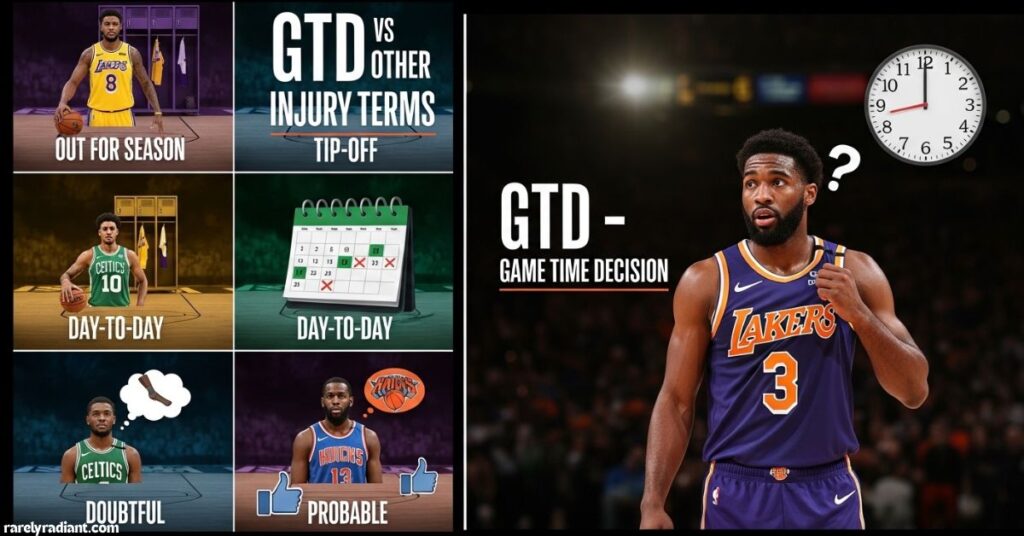
NBA injury reports contain several abbreviations.
Understanding them prevents confusion.
Comparison of Injury Status Terms
| Status | Meaning | Chance of Playing |
|---|---|---|
| Probable | Player expected to play | High |
| Questionable | Uncertain availability | Moderate |
| GTD | Decision made at game time | Unknown |
| Doubtful | Unlikely to play | Very low |
| Out | Player will not play | None |
Many fans confuse GTD and Questionable.
Here’s the difference.
Questionable means the team already believes the player might sit.
GTD means the decision will come during pre-game evaluation.
Related NBA Terms and Abbreviations
NBA injury reports use many abbreviations.
Knowing them helps fans read reports quickly.
Common Injury Terms
| Abbreviation | Meaning |
|---|---|
| DNP | Did Not Play |
| O | Out |
| Q | Questionable |
| P | Probable |
| GTD | Game Time Decision |
Additional NBA Availability Terms
Some phrases appear alongside official designations.
Examples include:
- Day-to-day – short recovery timeline
- Rest – player sitting for load management
- Return to competition reconditioning – conditioning after injury
These phrases help teams explain player absence without revealing private medical details.
Read Also: SYFM Meaning: Full Form, Text Slang Definition & How to Use It Online
Why GTD Matters for Fantasy Basketball
Fantasy basketball adds another layer of strategy.
Managers must predict player availability.
A GTD designation forces quick decisions.
How GTD Affects Fantasy Lineups
Starting a GTD player carries risk.
If he sits, the roster receives zero points.
However, benching him could waste a strong performance.
Fantasy players must weigh probability carefully.
Smart Fantasy Strategy
Experienced managers follow several rules.
Helpful tips
- Check injury reports hourly on game day.
- Keep bench players from later games ready.
- Monitor beat reporters on social media.
- Use late-swap features when available.
Preparation reduces the risk of lineup disasters.
Example Fantasy Scenario
Imagine this situation.
Your fantasy lineup includes a star guard listed as GTD with knee soreness.
You have two options.
| Decision | Risk |
|---|---|
| Start the player | Possible zero points |
| Bench the player | Miss potential big game |
Experienced managers consider factors such as:
- Injury history
- Team playoff position
- Back-to-back schedule
These clues help estimate playing probability.
Common Mistakes and Misunderstandings About GTD

Many fans misunderstand gtd meaning basketball reports.
Let’s clear up the most common myths.
Assuming GTD Means the Player Won’t Play
This assumption appears frequently.
In reality, many GTD players participate.
The designation simply signals uncertainty.
Assuming GTD Means the Player Will Play
The opposite mistake also occurs.
Fans sometimes assume GTD players always appear in games.
That’s not guaranteed.
Warm-up evaluations can change quickly.
Confusing GTD with Questionable
Although similar, these terms represent different decision stages.
| Term | Meaning |
|---|---|
| Questionable | Team unsure early in the day |
| GTD | Final evaluation happens during warm-ups |
Understanding this difference helps fans interpret injury reports correctly.
Frequently Asked Questions About GTD Meaning in NBA
What does GTD mean in NBA injury reports?
GTD stands for Game Time Decision.
It means the player’s availability will be determined shortly before the game begins.
What does GTD mean in basketball broadcasts?
Commentators use the term to indicate uncertainty about a player’s participation.
The final decision happens during warm-ups or minutes before tip-off.
How often do GTD players actually play?
Many GTD players do participate. However, the outcome depends on medical evaluation and coaching decisions.
When is the final GTD decision made?
Usually 30 minutes before tip-off after warm-ups.
Coaches announce the final lineup shortly afterward.
Is GTD the same as questionable?
No.
Questionable indicates uncertainty earlier in the day.
GTD signals the final decision will occur during pre-game evaluation.
Conclusion
The phrase GTD may look small inside an NBA injury report. Yet it carries enormous significance. It means Game Time Decision. The player might play. The player might sit. Medical staff evaluate the athlete during warm-ups before making the final call.
Understanding what does gtd mean in nba injury reports helps fans interpret updates more accurately. It also improves fantasy decisions, betting strategies, and general game knowledge. The next time you read a pre-game injury report and see GTD, you’ll know exactly what it means. The decision is coming soon. Just not yet.

Scott John is a seasoned content creator with over 4 years of experience specializing in heartfelt Captions, husband-wife relationship insights, milestone celebrations, brother-daughter bonds, and thoughtful gifting guides. His creative work is the heart behind rarelyradiant.com a platform dedicated to making every occasion meaningful and memorable.